

What Is the Menstrual Cycle? A Complete Guide to Understanding Your Monthly Cycle

Introduction
Every month, your body follows an extraordinary rhythm—one that prepares you for the possibility of pregnancy while also reflecting your overall reproductive health. This rhythm is known as the menstrual cycle.
Many people think the menstrual cycle is simply "your period." In reality, your period is just one part of a much larger process involving your brain, hormones, ovaries, and uterus working together in remarkable coordination.
Understanding your menstrual cycle is about more than knowing when your next period will begin. It helps you recognise what is normal for your body, identify changes early, make informed healthcare decisions, and better understand how your hormones influence your energy, mood, sleep, skin, and fertility.
Whether your cycles are regular or irregular, painful or painless, heavy or light, learning how your menstrual cycle works is one of the most empowering steps you can take toward understanding your reproductive health.
What Is the Menstrual Cycle?
The menstrual cycle is the monthly series of hormonal and physical changes that prepares the body for a possible pregnancy.
Each month, your body:
- Develops and matures an egg in one of the ovaries.
- Builds a nutrient-rich lining inside the uterus.
- Releases a mature egg during ovulation.
- Waits to see if fertilisation occurs.
- If pregnancy does not occur, sheds the uterine lining through menstruation, and the cycle begins again.
This process repeats throughout the reproductive years, beginning at puberty (menarche) and ending at menopause.
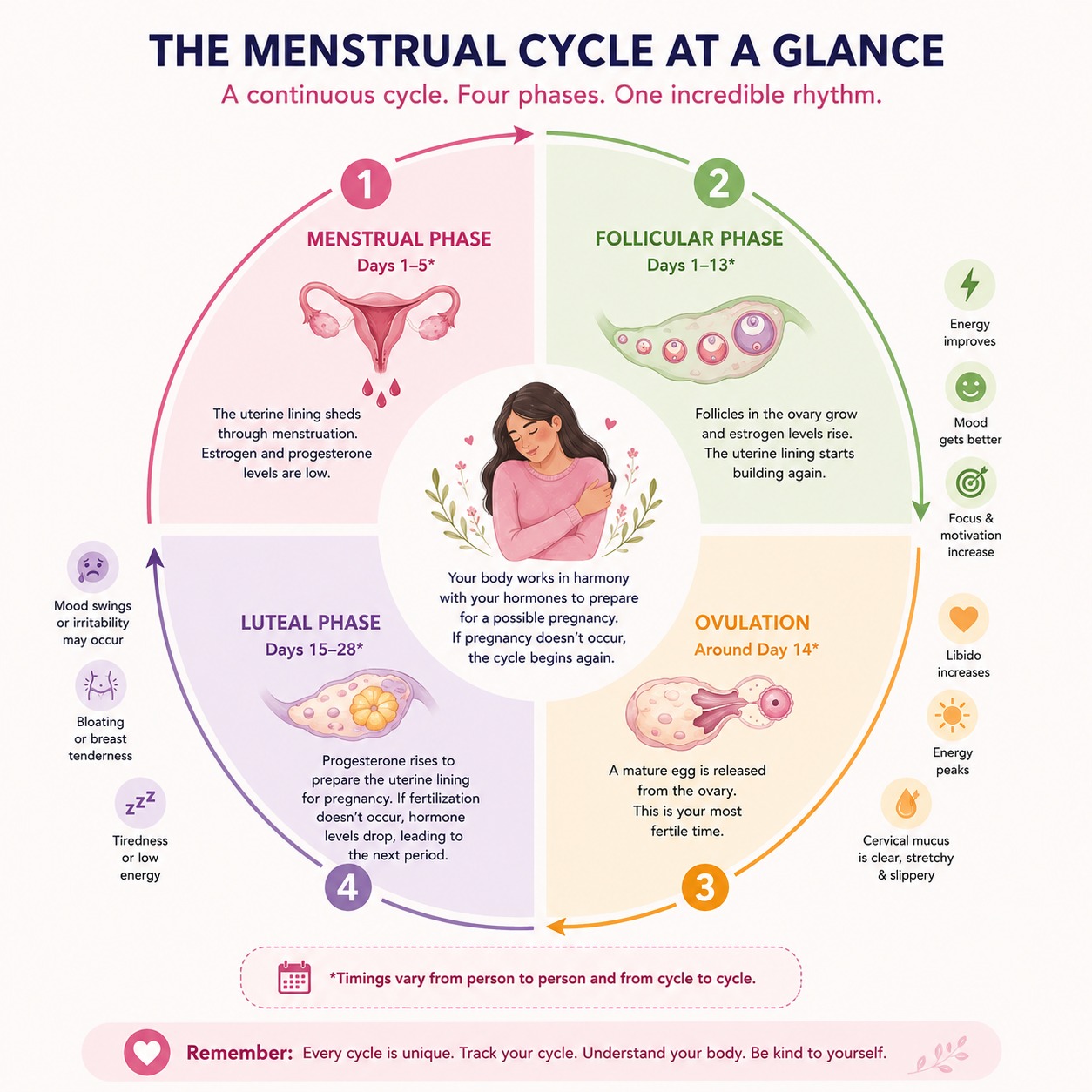
The Menstrual Cycle at a Glance
A menstrual cycle is a continuous process—not just the days you bleed.
Why Do We Have a Menstrual Cycle?
The menstrual cycle is the body's natural way of preparing for a possible pregnancy.
Each month:
- Hormones stimulate the growth of an egg.
- The uterus prepares a soft, nutrient-rich lining.
- If the egg is fertilised by sperm, pregnancy may begin.
- If fertilisation does not occur, the body sheds the uterine lining through menstruation and starts preparing again.
This monthly cycle is a normal and healthy part of reproductive life for most women.
The Four Key Organs That Work Together
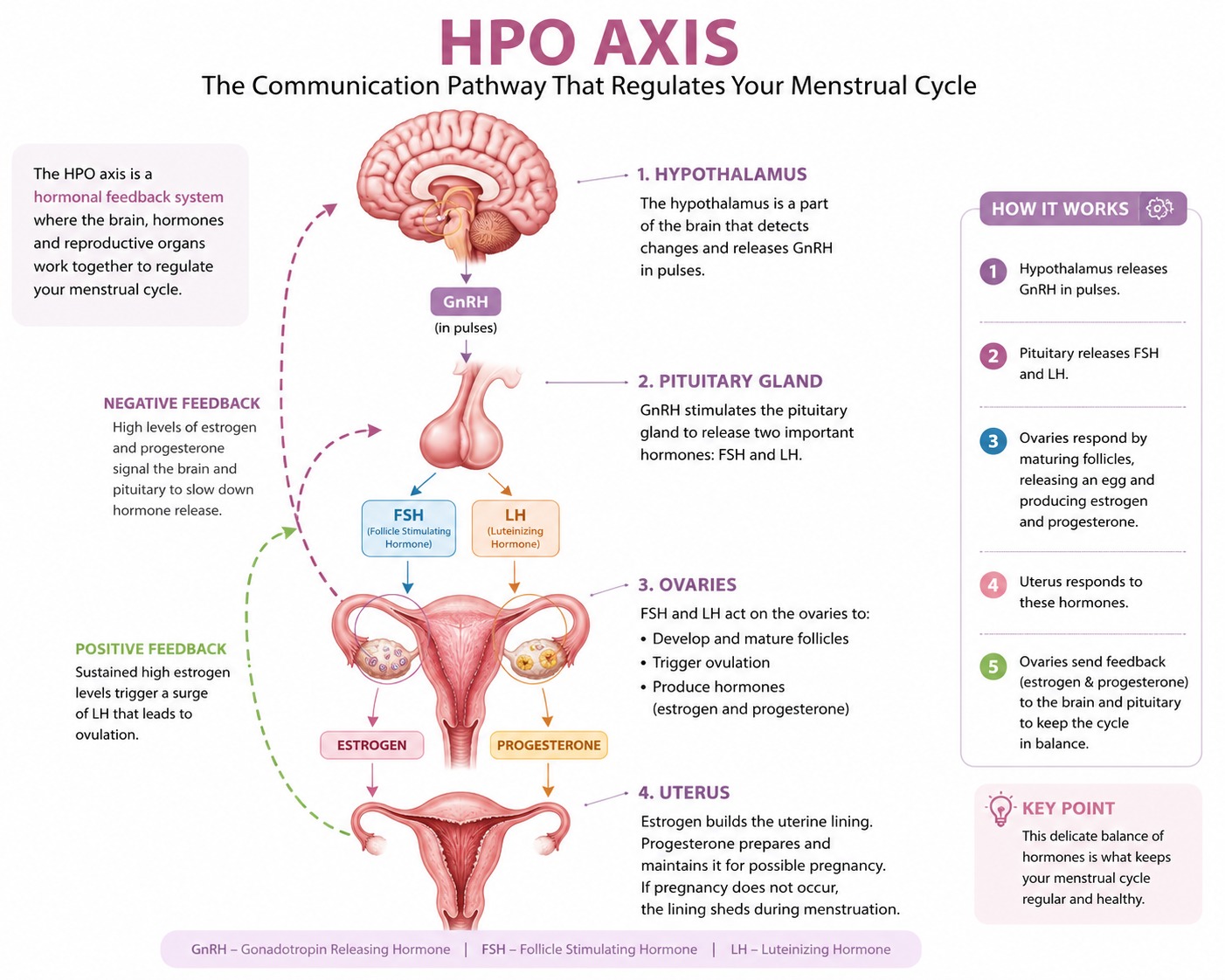
Your menstrual cycle is coordinated by four main parts of your body:
Organ | Role |
Brain (Hypothalamus) | Initiates the hormonal signals that begin the cycle. |
Pituitary Gland | Releases hormones (FSH and LH) that guide the ovaries. |
Ovaries | Mature and release an egg while producing estrogen and progesterone. |
Uterus | Builds and sheds its lining depending on whether pregnancy occurs. |
Together, these organs form a finely tuned communication network often referred to as the hypothalamic–pituitary–ovarian (HPO) axis.
The Menstrual Cycle Is More Than Your Period
Your period is only one stage of your menstrual cycle.
Throughout the month, your body experiences hormonal changes that can influence:
- Energy levels
- Mood
- Appetite
- Sleep quality
- Skin health
- Cervical mucus
- Libido
- Physical performance
- Fertility
Recognising these changes can help you better understand your body's natural rhythm rather than viewing your cycle only through the lens of menstruation.
Did You Know?
🔍 The average woman experiences approximately 400–500 menstrual cycles during her lifetime before menopause.
What Is Considered a Normal Menstrual Cycle?
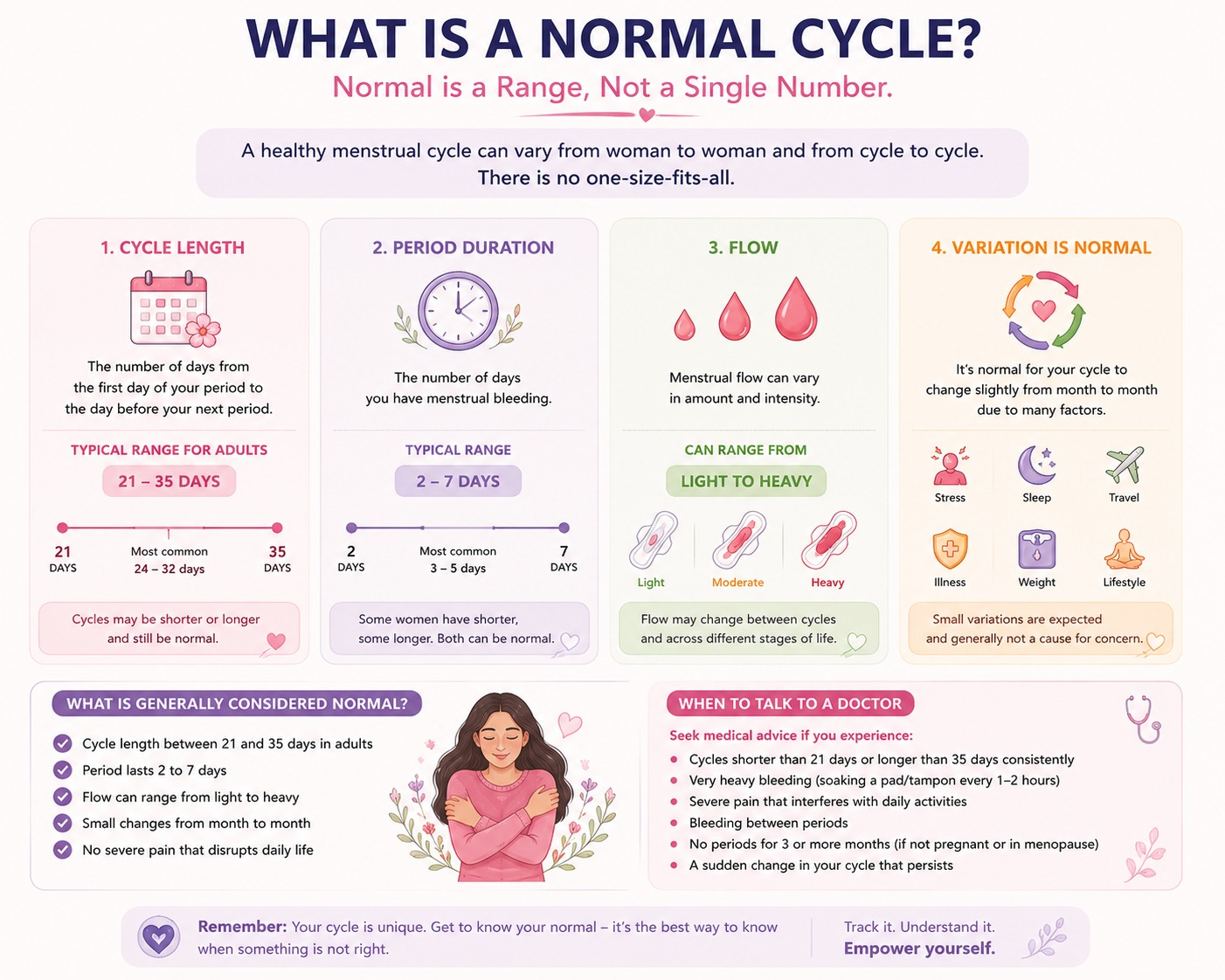
There is no single "perfect" cycle. A healthy menstrual cycle can vary from person to person.
For most adults:
- Cycle length: Typically 21–35 days.
- Menstrual bleeding: Usually lasts 2–7 days.
- Cycle variation: Small month-to-month differences are common.
- Flow: Can range from light to heavy and still be within the normal range.
Teenagers in the first few years after menarche may experience more irregular cycles as the body matures.
Common Myths About the Menstrual Cycle
Myth: A menstrual cycle is the same as your period.
Fact: Your period is only one phase of the menstrual cycle.
Myth: Every woman has a 28-day cycle.
Fact: Healthy cycles commonly range from 21 to 35 days in adults.
Myth: You always ovulate on Day 14.
Fact: Ovulation varies depending on cycle length and individual hormonal patterns.
Myth: Period blood is "dirty" blood.
Fact: Menstrual blood is made up of blood, uterine tissue, cervical mucus, and vaginal secretions. It is a normal biological process—not a way for the body to eliminate toxins.
Why Understanding Your Cycle Matters
Knowing your menstrual cycle can help you:
- Recognise what is normal for your body.
- Track changes over time.
- Identify symptoms that may need medical attention.
- Better understand fertility and ovulation.
- Prepare for your period with greater confidence.
- Have more informed conversations with healthcare professionals.
Your cycle is one of the body's natural health indicators, offering valuable insights into reproductive and overall well-being.
Frequently Asked Questions
Is it normal for my cycle to change slightly each month?
Yes. Small variations in cycle length or flow are common. Significant or persistent changes, however, should be discussed with a healthcare professional.
When does Day 1 of my menstrual cycle begin?
Day 1 is the first day of menstrual bleeding, not the day spotting begins.
Can stress affect my menstrual cycle?
Yes. Physical or emotional stress, changes in weight, illness, travel, and certain medications can all influence the timing of your cycle.
Can I have a healthy cycle without a 28-day pattern?
Absolutely. A healthy cycle does not have to be exactly 28 days. Many adults have naturally shorter or longer cycles within the normal range.
When should I consult a doctor?
Consider seeking medical advice if you experience:
- Very heavy bleeding (such as soaking through a pad or tampon every hour for several hours).
- Severe pain that prevents normal daily activities.
- Bleeding between periods.
- No periods for three consecutive months (if you're not pregnant, breastfeeding, or approaching menopause).
- Sudden, persistent changes in your menstrual pattern.
Key Takeaways
- The menstrual cycle is a monthly process that prepares the body for a possible pregnancy.
- Menstruation is only one phase of the cycle.
- The brain, pituitary gland, ovaries, and uterus work together through hormones to regulate the cycle.
- A normal adult menstrual cycle typically ranges from 21 to 35 days.
- Understanding your cycle can help you recognise changes, support your reproductive health, and seek timely medical care when needed.
What's Next?
Now that you understand what the menstrual cycle is, the next chapter explores how your body moves through four unique phases every month.
Continue Reading → The Four Phases of the Menstrual Cycle → On our next content
References
This article is based on guidance and educational resources from:
- World Health Organization (WHO) – Menstrual health and adolescent health resources.
- American College of Obstetricians and Gynecologists (ACOG) – Menstruation in girls and adolescents; menstrual cycle guidance.
- Royal College of Obstetricians and Gynaecologists (RCOG) – Patient information on menstrual health.
- International Federation of Gynecology and Obstetrics (FIGO) – Recommendations on normal and abnormal uterine bleeding.
- National Institute for Health and Care Excellence (NICE) – Heavy menstrual bleeding and menstrual health guidelines.